Brand Name Normalization Rules: Clean, Standardize & Match Brands
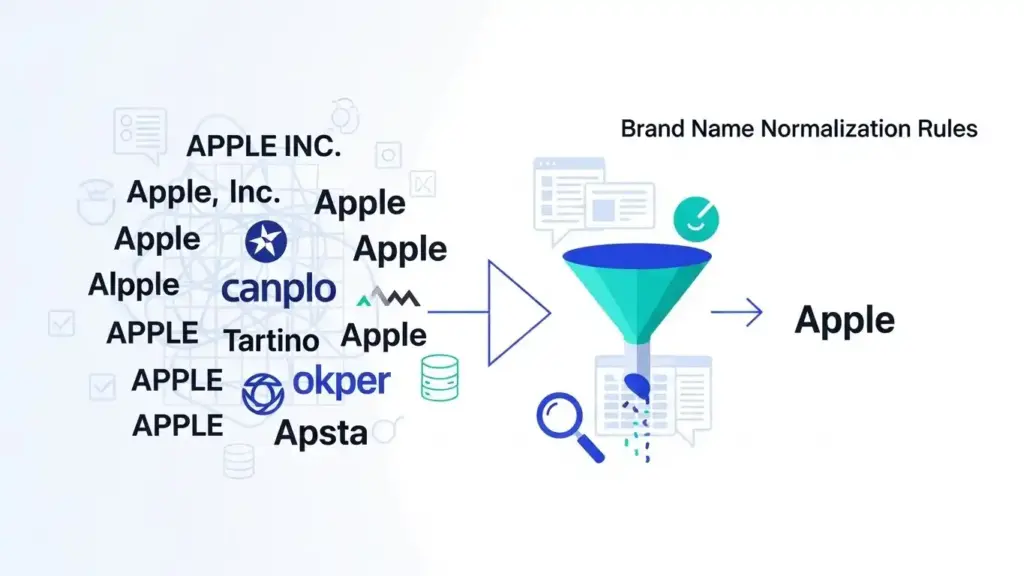
Brand names look simple—until they don’t. One spreadsheet says “Apple”, another says “APPLE INC.”, and a third says “Apple, Inc”. Meanwhile, someone typed “Appel” at 4:55 PM on a Friday. Suddenly, reports don’t match, customer records duplicate, and your analytics are doing somersaults.
That’s where brand name normalization rules come in. They’re the practical, repeatable rules you use to turn messy brand text into a consistent, searchable, report-ready format. Done well, normalization improves data quality, entity matching, deduplication, CRM hygiene, and brand governance—the whole nine yards.
What is brand name normalization?
Brand name normalization is the process of converting brand names into a standardized form, using rules that reduce variations without losing meaning.
In plain English: it’s how you make sure “Coca-Cola”, “Coca Cola”, and “COCA‑COLA CO.” map to the same normalized brand name.
Normalization is commonly used in:
- CRM and customer databases
- E-commerce catalogs and product feeds
- Marketing attribution and analytics
- Finance/vendor master data (MDM)
- Search, tagging, and content systems
Why brand name normalization rules matters (more than you think)
When brands aren’t normalized, the problems pile up fast:
- Duplicate records: “Nike” vs “NIKE, Inc.” looks like two different vendors.
- Broken reporting: revenue splits across variations, making totals unreliable.
- Bad segmentation: audiences fragment across “Meta” and “Facebook.”
- Search mismatch: users can’t find what you already have.
- Costly manual cleanup: humans keep fixing the same mistakes… again and again.
And yep, it’s a trust issue too. If your dashboard can’t agree on a brand name, people stop believing the numbers.
Core brand name normalization rules (the ones that actually work)
Below are practical brand name normalization rules used in real systems. Pick what fits your context—because, well, “perfect” normalization depends on your goals.
1) Trim whitespace and normalize spacing
Start with the boring stuff. It pays off.
Rule:
- Trim leading/trailing spaces
- Replace multiple spaces with one
Example:
" Samsung Electronics "→"Samsung Electronics"
2) Standardize letter casing (with an exception)
You usually want consistent casing.
Rule (common): Convert to Title Case or keep as Official Brand Case.
Rule (exception): Preserve deliberate casing like iPhone, YouTube, eBay where case signals identity.
Examples:
"MICROSOFT"→"Microsoft""iphone"→"iPhone"(exception list)
3) Normalize punctuation (but don’t bulldoze meaning)
Punctuation creates duplicates, but removing everything can cause collisions.
Rule:
- Replace fancy punctuation with plain equivalents (smart quotes → straight quotes)
- Standardize hyphens (–, —, ‑ → -)
- Remove trailing periods in abbreviations if your system prefers it
Examples:
"L'Oréal"→"L'Oreal"(if accent removal is also applied)"Procter & Gamble"vs"Procter and Gamble"→ decide a standard
4) Remove or standardize legal suffixes (Inc, LLC, Ltd)
Legal suffixes are useful in vendor management, but often noise in analytics.
Rule options:
- Option A (analytics/search): remove suffixes
- Option B (compliance/finance): keep suffixes in a separate field
Common suffixes to handle:
- Inc, Incorporated
- LLC, L.L.C.
- Ltd, Limited
- PLC
- GmbH, S.A., S.p.A. (region-specific)
Example:
"Acme Inc."→"Acme"(normalized brand)- Store
"Inc."inlegal_suffixif needed
5) Standardize “and” vs “&”
This one’s sneaky. People type both, and systems treat them as different.
Rule: Choose one canonical form.
- Either always use “and”
- Or always use “&”
Example:
"H&M"is not “H and M” in most contexts, so keep it as an exception.
6) Normalize common abbreviations (carefully)
Abbreviations can help matching, but they can also create false matches.
Rule: Maintain a controlled abbreviation map, approved by your data owner.
Examples:
"Intl"→"International""Co"→"Company"(only when you’re sure it’s a suffix, not part of the brand)
7) Handle diacritics and Unicode characters
Accents and special characters cause duplicates across systems.
Rule (common): store two versions
brand_display_name(original, for UI)brand_normalized_name(diacritics removed, for matching)
Example:
"Beyoncé"→"Beyonce"(normalized)
8) Remove stop-words only when they’re truly generic
Words like “the” and “group” may be noise… or they may be identity.
Rule: Remove stop-words only if your organization has evidence it improves matching and doesn’t create collisions.
Example:
"The North Face"should not become"North Face"in many catalogs.
9) Use canonical brand names (the “golden record” approach)
If you can, don’t rely on rules alone. Use a brand dictionary.
Rule: Map known variants to one canonical name:
- Canonical:
"Alphabet"- Variants:
"Google parent company","Alphabet Inc","ALPHABET"
- Variants:
This is classic master data management (MDM) and entity resolution—fancy terms for “one source of truth.”
10) Keep parent/child brand relationships separate
Normalization isn’t the same as hierarchy.
Rule: Store relationships in dedicated fields:
brand(consumer-facing)parent_company(corporate entity)sub_brand(line/series)
Example:
- Brand:
"YouTube" - Parent:
"Alphabet"
Trying to cram that into one normalized text field is asking for trouble.
A simple normalization workflow (from messy to consistent)
Here’s a practical order of operations:
- Clean input: trim spaces, normalize Unicode, unify punctuation
- Apply casing rules: title case + exception list
- Standardize connectors: “and” vs “&”, hyphens, apostrophes
- Remove/parse legal suffixes: separate fields when needed
- Apply dictionary mapping: known variants → canonical brand
- Run match checks: detect collisions and false positives
- Review exceptions: add edge cases to your exception list
Done right, this becomes a repeatable pipeline—not a recurring headache.
Brand name normalization examples (real-world style)
| Raw Input | Normalized Brand Name | Notes |
|---|---|---|
APPLE INC. |
Apple |
Removed legal suffix |
Procter & Gamble |
Procter and Gamble |
Standardized connector |
Coca‑Cola Co |
Coca-Cola |
Normalized hyphen + suffix removal |
L’OREAL |
L'Oreal |
Quote normalized + casing |
The North Face |
The North Face |
Stop-word preserved |
Common mistakes to avoid (learned the hard way)
- Over-normalizing: turning distinct brands into the same string (collision city).
- No exception list: you’ll break brands like iPhone, eBay, H&M, AT&T.
- Mixing legal entities with consumer brands: finance needs one view, marketing needs another.
- Not versioning the rules: when rules change, reports shift—people notice.
- Skipping audits: you need a way to measure match accuracy and drift.
Where “Business Name” fits into normalization
Sometimes you aren’t just normalizing brands—you’re standardizing the overall Business Name used across forms, directories, CRM records, and vendor lists. And honestly, naming consistency upstream prevents a lot of cleanup downstream.
If you’re working on naming conventions, brand foundations, or you’re starting from scratch, this resource may help: Business Name.
Quick checklist: brand name normalization rules you can adopt today
- Trim whitespace + normalize internal spaces
- Unify Unicode punctuation (hyphens, quotes)
- Apply casing with exceptions (iPhone, eBay, etc.)
- Decide how to treat “and” vs “&”
- Remove or separate legal suffixes (Inc, LLC, Ltd)
- Store display name and normalized name separately
- Maintain a canonical brand dictionary (variants → golden record)
- Track parent/sub-brand relationships in separate fields
- Monitor collisions and false matches
FAQ: Brand name normalization rules
Are normalization and deduplication the same thing?
Not quite. Normalization standardizes the text; deduplication decides whether two records represent the same entity. Normalization helps deduplication, but it doesn’t replace it.
Should I remove “Inc” and “LLC” every time?
Only if your use case supports it. For marketing analytics, removing them usually helps. For contracts, payments, and compliance, you may need them—just store them separately.
What’s the best format for normalized brand names?
The best format is the one that’s consistent, search-friendly, and aligned with how your team uses the data. Many teams use:
brand_display_name(official styling)brand_normalized_name(matching key)
Summary (key takeaways)
Brand name normalization rules turn messy, inconsistent brand strings into a reliable standard for matching, reporting, and search. Start with basics (spaces, punctuation, casing), then handle legal suffixes and connectors, and finally lean on a canonical brand dictionary for best results. Keep exceptions, avoid over-normalizing, and separate corporate structure from the brand name itself.